
BaKIM - Urban Tree Monitoring
Solution Brief
BaKIM - Healthy Trees Through Artificial Intelligence
March 30, 2026
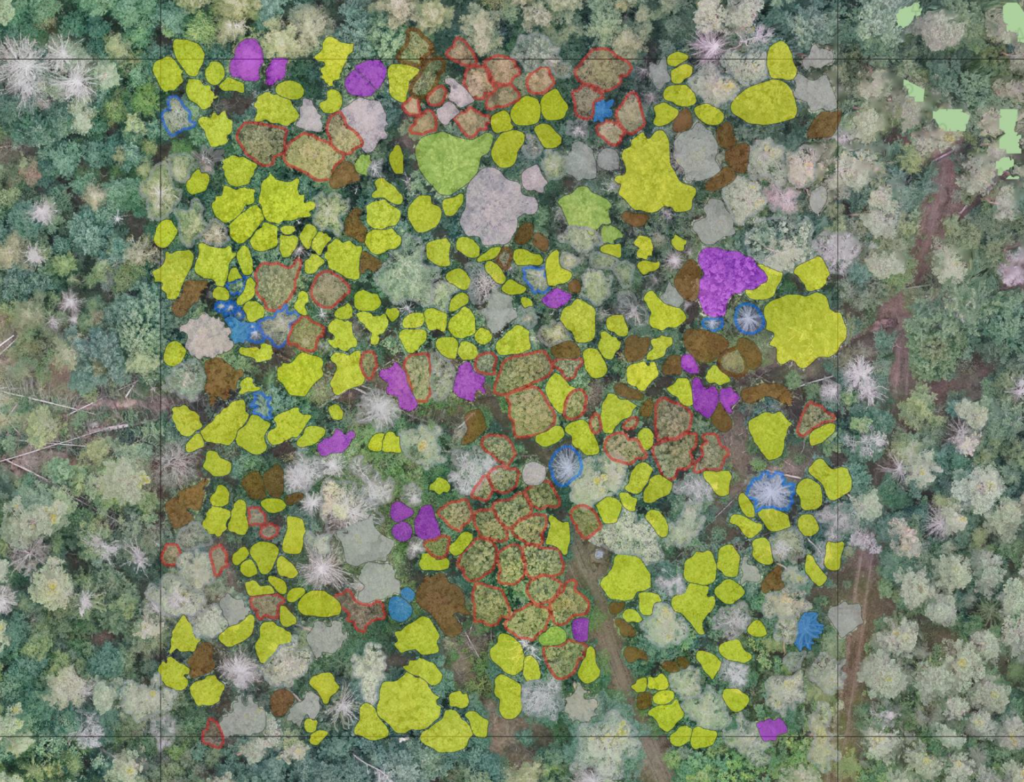
BaKIM uses AI and high-resolution drone imagery to support tree inventory and tree health monitoring. It helps municipalities detect stress earlier, prioritise interventions and manage urban green spaces more efficiently.
This gives municipal staff working in tree management and forestry a better overview of large areas. Instead of relying only on time-intensive field checks, they can see more quickly where trees require attention, where drought stress or pest pressure may be emerging, and where maintenance measures should be prioritised. BaKIM does not replace fieldwork; it makes it more targeted, faster and more efficient.
Technically, BaKIM combines cost-effective drone data collection with a scalable AI pipeline based on deep neural networks. Supported by scalable European cloud resources, the solution makes advanced image analysis usable for municipalities without requiring in-house AI infrastructure or major new development processes.
Detecting tree stess early
BaKIM helps to identify where tress may already be affected by drought, pests or mistletoe infestation. This supports ealier and more targeted intervention.
Analysing large areas efficiently
By combining drone imagery with AI, BaKIM supports the assessment of extensive tree stocks much faster than manual inspection alone. This saves time and helps municipal staff focus fieldwork where it is most needed.
Transferable to other municipalities
The solution provides GIS-compatible results that can be integrated into planning, maintenance and forestry processes. Its underlying approach is designed to be transferable to other municipalities, making it easier to adopt AI-supported tree monitoring.
In focus

Related German Aticle: What if we could re-use the potential of AI for urban tree monitoring?
Das Projekt BaKIM wurde mit dem Ko-Pionier-Preis ausgezeichnet, weil es exemplarisch zeigt, wie digitale Lösungen erfolgreich zwischen Kommunen übertragen werden können. Die ursprünglich in Bamberg entwickelte Anwendung wurde von Lemgo als erste Stadt nachgenutzt und gemeinsam weiterentwickelt – deutlich schneller und kosteneffizienter, als eine eigene Lösung neu aufzubauen.
Der Ansatz steht damit für einen neuen Standard in der Verwaltungsdigitalisierung: Zusammenarbeit und Wiederverwendung statt isolierter Neuentwicklung.
More information about the BaKIM Project, financed by the city Bamberg and the Otto-Friedrich University Bamberg, and implemented by the Digital Innovation Unit at GFA Consulting Group, can be found on the Smart City Bamberg Webpage: BaKIM – Smart City Bamberg.